

F1 New Pit Stop Rules
Formula 1 pit stops are a crucial part of any race. Become them incorrect, and your race can be a disaster. Become them right, and information technology can win yous a race. But pit stop strategies and the number of pit stops in a race differ and are barely ever the same for drivers during a race. So, let'south expect at how many pit stops are in a Formula 1 race?
Drivers make betwixt 1-3 pit stops during an F1 race. The number of times a commuter will finish will depend on the weather, runway weather condition, their rivals' strategies, and potential car damage. However, drivers are required to finish at least once in a race to change their tires.
The strategy behind stops and the bodily pit stops themselves are complicated processes. They depend on a variety of factors and rely on highly trained individuals to execute them with ease. And so, let'southward have a expect at all the intricacies behind this vital part of an F1 race.
If you lot're looking for some F1 merchandise, check out the awesome stuff at the official F1 store hither.
How Many Pits End Are in An F1 Race?
Pit stops are a vital part of a Formula ane race. Fresh tires allow cars to become faster because they provide more grip. However, pit stops take time because drivers must drive slowly in the pit lane, and the tire changing process can have anywhere between 1.8-15 seconds, depending on how quick the pit crew is. They more often than not have effectually 2-four seconds if everything goes to plan.
Therefore, information technology is crucial to get the correct balance during a race weekend. Too many pit stops tin can slow you down because of the time wasted during a pit stop, only too few tin can cost yous on the rails considering older tires hateful less speed.
During a race, drivers will end anywhere between 1-3 times, depending on strategy and/or damage sustained during the race. Sometimes it may be more than than three, just this is extremely rare. In dry atmospheric condition atmospheric condition, F1 drivers are required to consummate at least ane pit stop. During this pit terminate, they must also change tire compounds as two different dry-weather (slick) tire compounds must exist used during a race.
There are five slick tire compounds used during a Formula 1 flavour. These are on a scale of softness to hardness. Harder tires are more than durable and therefore final longer during a race merely provide less grip, which results in less speed. Softer tires are much less durable, so they don't last very long during a race, but the trade-off is that they provide a lot of grip and are much quicker than hard tires.
In that location are as well medium tires, which autumn in-between the soft and hard tires on the scale. They offer a bit of both tire. They provide more durability than soft tires, but non as much as hard tires offering. Withal, they are quicker than difficult tires just not as fast as soft tires.
During an individual race weekend, Pirelli, who articles all the Formula 1 tires, volition cull three of the v tire types to be used during the weekend. The hardest of these tires will be designated as the hard tire for the weekend, the softest 1 volition exist the soft tire for the weekend, and the compound between the two will be the medium tire for that race weekend.
The tires used will always be next to each other on the spectrum, and so that means you won't use the hardest tire on the range and the softest tire on the spectrum on the same weekend.
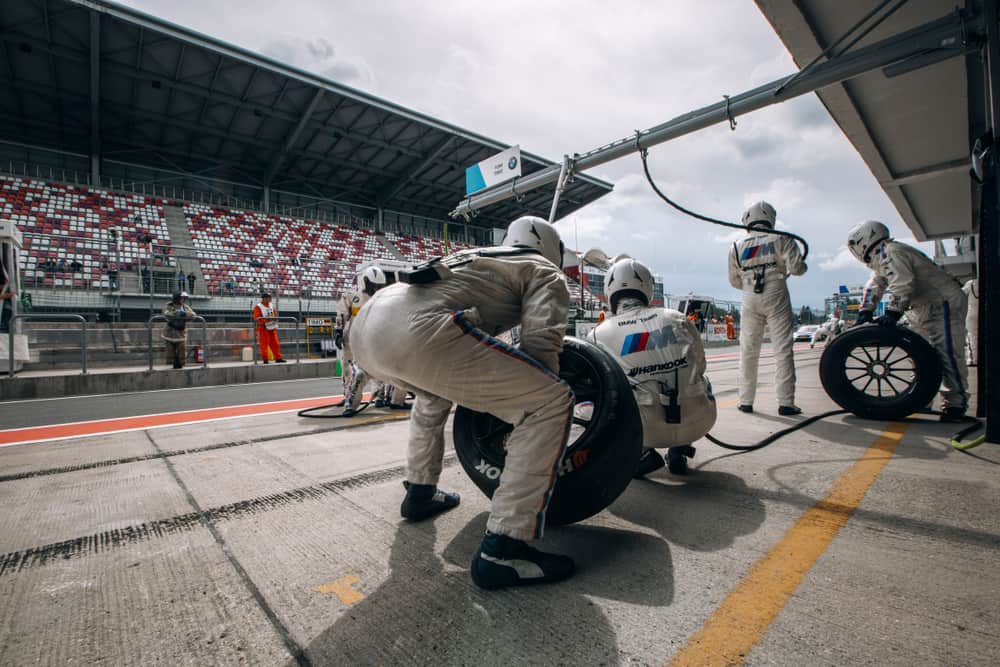
According to Pirelli, every bit of 2021, drivers will receive "two sets of difficult tires, three sets of mediums, and eight sets of softs (soft tires) per race weekend. It is up to their team to manage their tires throughout all the practice and qualifying sessions to ensure they accept a practiced tire choice to apply during the actual race. The important thing is to ensure that drivers have at to the lowest degree two unlike compounds available to exist used during the race.
How All the Tyres Are Used During a Formula 1 Race Weekend
The gratis exercise sessions starting on a Friday are typically used to run various tires and setups to allow the teams to collect a lot of data. This data will then be combined with simulations and data from previous events to decide the optimal tire strategy during the race.
Teams must accept a variety of tires that have non been used or have simply been used for one or two laps for selection during the race. They need to be able to answer to changes in weather and strategic decisions fabricated by their rivals.
Drivers use all kinds of strategies depending on the track and their rival'south strategic decisions. For case, a driver may outset the race on soft tires, then pit after around 15-twenty laps, put medium tires on for the middle sector of the race, and then pit over again towards the end of the race for another set of soft tires to maximize the speed at the end of the race.
Or, they could kickoff on soft tires, and then after fifteen-xx laps, alter to hard tires and stay on those hard tires until the finish of the race.
Undercuts and Overcuts: The Potential F1 Pit Stop Strategies
Yous may take been watching a Formula 1 race and heard the commentators talking about overcuts and undercuts concerning pit stops. These terms can be confusing, then allow'south explore them in a bit more than particular.
Undercut
An undercut involves making your pit cease earlier than the car in front of you. You, therefore, go onto fresher tires, which means you lot have a pace reward compared to the motorcar you are chasing, which will be on much older tires.
The idea backside the undercut is that you use these fresher tires to overtake the commuter ahead of you, who will be slower than you lot on their older tires, or y'all force the car ahead of you besides to make a pit finish. Once the driver in front has been overtaken, they volition ofttimes make a pit cease of their ain and therefore be on fresher tires.
Nonetheless, if it all goes to program, the car pitted earlier will take built a big enough gap between themselves and their rival to ensure that they tin can't be defenseless.
The issue with undercutting is that it can sometimes backfire if the car you lot are chasing pits much after than you. They can and then use this reward of fresher tires to catch you because you take much older tires.
Therefore, undercutting is all well-nigh proper execution as it requires the chasing driver to catch the driver ahead of them and and then maintain their lead on slightly older tires.
The Overcut
The overcut is the contrary of the undercut. Instead of pitting before the motorcar you are chasing, you wait for them to pit and continue out on track, gaining track position. The idea behind this is that while they are pitting and warming up their fresh tires afterward, you accept the opportunity to build a large enough gap over them then that when yous pit, y'all come out ahead of them.
This strategy is risky, though. It relies on the commuter to properly manage their tires and extract maximum operation from their aging tires. It is as well about timing the planned pit stop correctly as it is essential not to wait likewise long as this would ultimately compromise the commuter's speed out on the track considering of how old their tires will exist. Therefore, this strategy is used much less than the undercut.
F1 Pit Stops in Moisture Weather Races
During a race where it rains, drivers are not hindered past the rules for races in dry conditions. They do not have to use at least ii different tire compounds during the race.
However, drivers usually utilize multiple compounds during a moisture weather race considering of how slow the wet weather condition tires are compared to the dry out tires. Moisture weather tires have treads on them to aid readapt the water, but this gives drivers less grip with the track, and this, combined with the slippery nature of the rails, is not a recipe for maximum speed.
Therefore, during a race that starts in the rain, teams, and drivers are looking for the first opportunity to switch to dry-weather tires. Teams volition often put on intermediate tires if the track isn't sufficiently dry for the slick dry out weather tires. These offering some h2o deportation and a bit more speed than the full wet atmospheric condition tires, which displace a lot of water merely don't provide about as much grip equally the other tires.
Information technology can be quite risky to switch to dry conditions tires, which means that timing is everything. If the slick tires are fitted too early, the commuter is more likely to slide off the track. However, if they are put on too tardily, the commuter volition be at a disadvantage compared to the other cars running slick tires.
What Are Some of The Key Terms Used in Formula i Pit Stops?
You will ofttimes hear words used by drivers and their race engineers during a Formula i race that doesn't make much sense. It is important to understand what these words/phrases mean to properly sympathise pit stops in Formula i. The 2 main words/phrases you should know are 'box' and 'double-stack.'
Box
Box is used interchangeably with 'pit' and is oftentimes used more regularly. It is used past drivers and their race engineers to indicate that the driver needs to come in for a pit stop. Information technology is derived from the German word boxenstopp, which ways pit stop. It will ofttimes be used twice for maximum efficiency, which is why you will oft hear the race engineer telling their driver to 'box, box.'
Double Stack
Double stacking means to pit both cars from the same team in the same lap. The leading car volition go into the pits and get their tires changed, and immediately afterward, their teammate volition repeat the process in that same lap.
This is often washed when a safety car is deployed for a hazard on track because drivers volition lose less time coming in for a pit end. Depending on the track, the entire pit stop procedure can accept twenty-30 seconds if everything goes to program. Therefore, pitting nether a safety car when the cars out on track cannot overtake and are bunched together is beneficial, every bit much less time is lost.
However, double stacking can be dangerous as it requires more focus and skill from the pit crew than a routine pit terminate. They have to have both sets of tires ready, brand certain they don't get mixed upwards, and ensure that the quondam tires from the first motorcar don't impede the 2nd car or the pit crew.
Sometimes double stacking tin can go horribly wrong as it did for Mercedes at the Sakhir Grand Prix in Bahrain in 2020. George Russell, filling in for Lewis Hamilton and Valtteri Bottas, had the wrong tires put onto their automobile. Russell received Bottas's tires, and Bottas was given Russell's tires. Every bit individual drivers are allocated a specific number of tires for a race weekend, this was illegal, and they had to rechange the tires, which lost both drivers a lot of fourth dimension.
How Formula one Pit Stops Work
After the driver has been told to 'box,' their fate is no longer in their hands merely rather in the hands of their pit crew. They rely on their pit crew to perform a rapid tire alter to ensure they spend the to the lowest degree amount of time possible stationary in the pit box.
Once drivers enter the pitlane, they must slow down to 80kph (50 mph) in the race. This is to ensure the safety of the pit crews and anybody working in and effectually the pit lane. Drivers take a special button on their steering wheels that they press, which limits their speed automatically in the pit lane. However, if drivers fail to respect the speed limit, they will receive a time penalty.
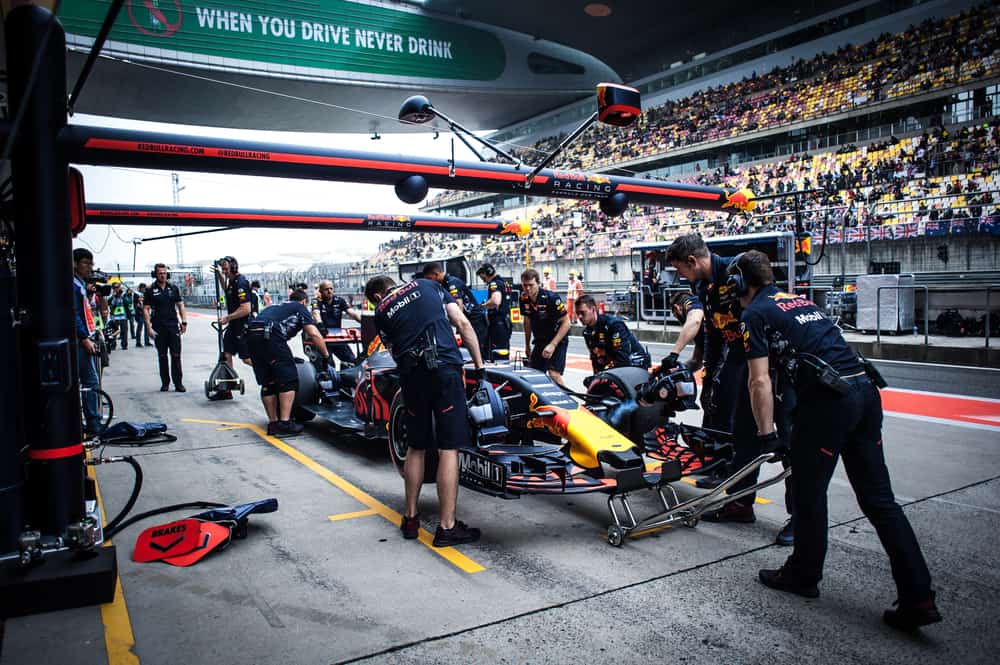
Pit stops in Formula ane are a complicated procedure and involve over 20 people. Teams practise them for hours during the offseason and in betwixt track sessions on a race weekend. They must exist equally quick equally possible every bit in Formula one; mere split seconds can be the divergence betwixt coming out alee or backside a chasing car.
Each of the 23 people involved in a pit finish has a specific role, and all are equally crucial as the rest. A front jackman and a rear jackman are responsible for lifting the car off the basis to change the tires. The jacks they utilize cost over $300.000 as they are highly specialized pieces of equipment that need to lift the motorcar with ease.
Some four-wheel gunners are responsible for unfastening the old bicycle and fastening the new cycle. Someone removes the old tire to help the bike gunners, and another person helps put the new cycle on. Therefore, for each wheel attachment on the motorcar, at that place are three people responsible for the wheels.
Two mechanics are likewise responsible for holding the car steady while the pit stop is taking place, and another two adjust the front olfactory organ cone if necessary.
One time the car has been stopped, the mechanics will quickly change the tires. Ever since mid-race refueling was banned in 2010, the average pit finish time if no forepart fly change is required is around 2 to 3 seconds. However, if the front wing has been damaged and needs to exist changed, pit stops will take well over 10 seconds every bit it takes much longer to remove and replace the front fly than information technology does with tires.
Red Bull performed the fastest pit stop in Formula 1 history at the 2019 Brazilian Grand Prix, and they changed Max Verstappen's tires in only 1.82 seconds.
This does not include the time it takes for drivers to enter and exit the pit box. The unabridged procedure takes between 20-30 seconds, depending on the length of the pitlane at the specific track.
Decision
Pit stops in Formula 1 are a key part of whatever race. As the unabridged procedure takes between 20-30 seconds and can happen anywhere between i-3 (perhaps even more), the risk-advantage ratio is pregnant. Therefore, they must exist performed with maximum efficiency to ensure as piddling time is lost.
But, if you get them right, they can turn the race on its head and allow yous to gain an advantage over your rivals, and for those at the front end, this can be the difference between winning and coming second.
Sources
- https://www.formula1.com/en/latest/article.aero-tweaks-new-tyres-and-the-toll-cap-the-2021-f1-rules-and-regulation.r1cq36aI6bvzMeZtiFru3.html
- https://www.sportskeeda.com/f1/what-formula-1-s-fastest-e'er-pit-stop
- https://www.formula1.com/en/latest/article.gone-in-i-88s-putting-together-the-perfect-f1-pit-terminate.3lLKnEoPKdJgACsUn9IltC.html
- https://flowracers.com/blog/undercut-overcut-double-stack-f1-pit-stops/
- https://www.carthrottle.com/postal service/all-you-need-to-know-near-a-formula-1-pit-stop/

F1 New Pit Stop Rules,
Source: https://onestopracing.com/how-many-pit-stops-are-there-in-f1/
Posted by: piercefolady.blogspot.com
0 Response to "F1 New Pit Stop Rules"
Post a Comment